Roommate chore chart: a printable you can fill in
A chore chart on the fridge works when everyone agrees to it, and when the jobs on it are about the same amount of work. Many charts you can download skip the second part: one roommate gets “take out the trash” for the week, another gets the bathroom.
This one is built from the starter list in Evenchores, where each chore has an effort score from 1 (quick) to 5 (huge). It splits a shared apartment’s weekly chores into three zones that are close in size, and rotates them so that over three weeks everyone does exactly the same work.
What goes on the chart
Only the shared spaces. Your room, your laundry and your own dishes stay off it.
Leave the small daily things off too: wiping the counter, putting dishes in the dishwasher, tidying the living room. Those work best as one house rule, “if you use it, you clean it”, not as a turn.
Here’s what’s left, the weekly chores of a typical apartment, with their size:
| Zone | Chores (size) | Points |
|---|---|---|
| Bathroom | Clean the toilet (2), the sink (1) and the shower (3), mop the floor (2), restock toilet paper (1) | 9 |
| Kitchen | Clean the stovetop (2) and the sink (1), mop the floor (3), recycling (1), trash cans to the curb (1) | 8 |
| Living room & trash | Vacuum (2), dust (2), shake out the doormat (1), take out the trash twice (1 + 1) | 7 |
| Once a month | Clean out the fridge (3) | 3 |
The zones aren’t exactly equal, 9, 8 and 7 points, and they don’t have to be. Each roommate takes one zone a week and moves to the next one the week after. After three weeks, everyone has done 24 points. The fridge goes to a different person each month.
Four people? Make the trash its own zone. Just two of you? Regroup the same chores into two zones of about 12 points each, or see how to split chores fairly with a partner.
The chart
Write your names in week 1, then move everyone down one zone each week. Print it, or save it as a PDF from the print window.
Our chore chart
| Zone | Week 1 | Week 2 | Week 3 | Week 4 |
|---|---|---|---|---|
| Bathroom toilet, sink, shower, floor, toilet paper · 9 | ||||
| Kitchen stovetop, sink, floor, recycling, trash cans to the curb · 8 | ||||
| Living room & trash vacuum, dust, doormat, trash twice · 7 |
This month, the fridge: ______________________
Our agreement
- Zones change every ______________ (day).
- If you use it, you clean it: dishes, counters, the living room.
- Away for the week? Tell the others first. Your zone goes to whoever's next, and the rotation keeps going.
- Swaps are fine. Write them on the chart.
- Shared supplies (toilet paper, dish soap, trash bags): ______________________________
- We look at this together on ______________ of each month.
Signed: ____________________ ____________________ ____________________
Make the agreement before the chart
The chart only works if everyone agreed to it. Sit down once, all of you, and go through the agreement together. The blanks are the parts houses do differently: which day the zones change, and how you handle toilet paper and dish soap. Most fights about chores are really about those.
Then sign it. It sounds silly, but a list everyone put their name on is a lot easier to point to than a rule one person made up.
When the paper stops working
A paper chart has two weak spots. Someone has to remember to move everyone along each week, and it can’t tell who’s actually doing the work. After a month or two, people stop looking at it.
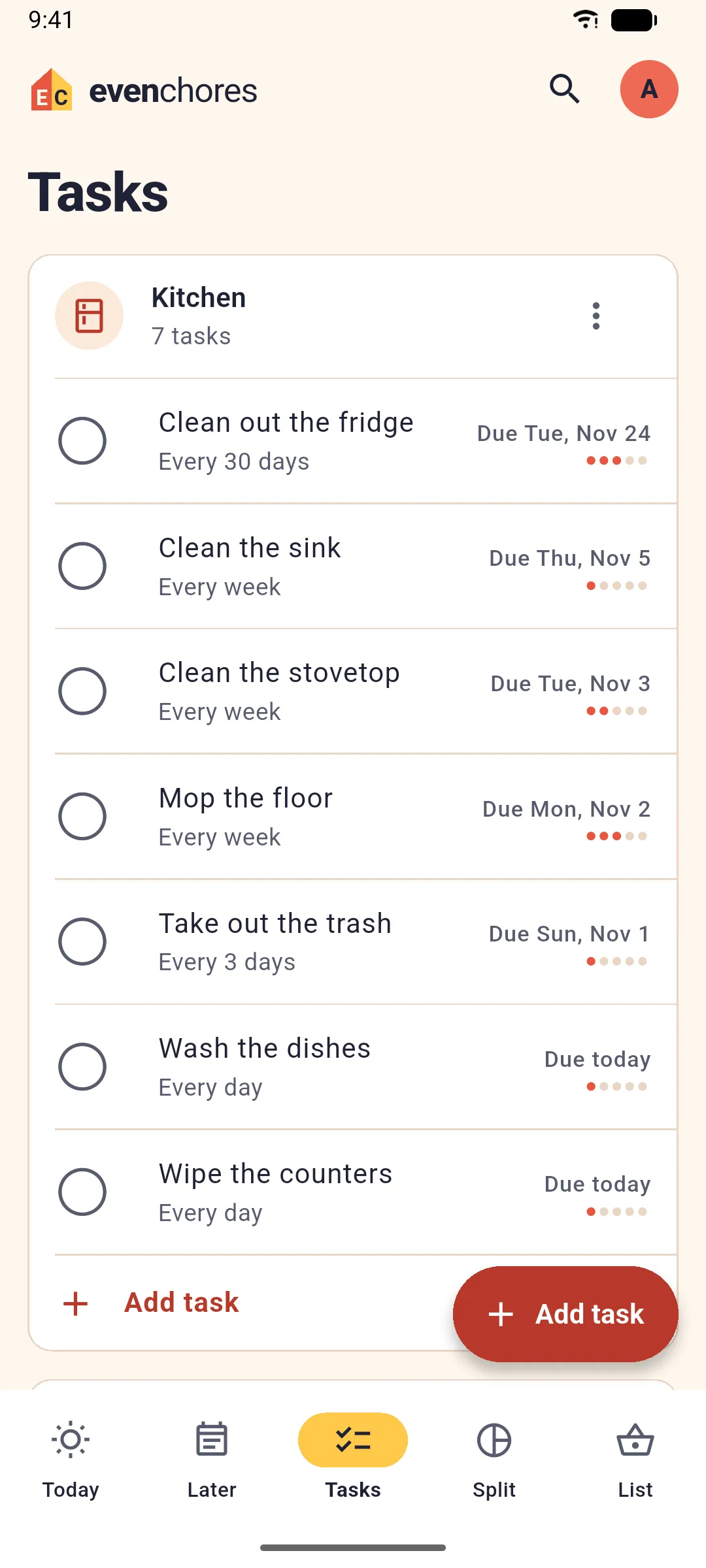
That’s what Evenchores is for. You set up the same chores once, pick Take turns under Who, and the app moves the turns along by itself, skips whoever’s away, and shows everyone what’s theirs today. The Split tab adds up everyone’s points, so the monthly check takes a minute. Everyone joins from a link, with no account.
The short version
- Put only the shared spaces on the chart. Daily small things are a house rule.
- Group the weekly chores into zones of about the same size.
- Rotate the zones every week. Over a full rotation, everyone does the same work.
- Agree on the blanks together and sign it.
- Look at it once a month.