How to split chores fairly with a partner
Most couples who argue about chores aren’t arguing about one dish. They’re arguing about the feeling that one of them does more. Sometimes that’s true. Sometimes it only looks true, because one person does lots of small things everyone sees and the other does a few big ones nobody notices.
The fix isn’t a perfect 50/50. It’s agreeing on what “fair” means for the two of you, and then being able to see whether you’re there.
How big the gap usually is
In the US, women spend about 2.4 hours a day on housework and men about 1.6, according to the American Time Use Survey (2025). That’s close to 50 minutes a day, or almost six hours a week.
The same survey shows it isn’t the same kind of work, either. Women do more of the cooking, cleaning and laundry, the jobs that come back every day. Men do more of the yard work and repairs, which come up less often. And in a 2019 study of over 10,000 people, feeling that the split was unfair to you went with a less happy relationship. So you need both: a fair split, and a way for both of you to see it.
Counting chores gets it wrong
Here’s a normal week for Ana and Ben. The chores and their sizes come from the starter list in Evenchores, where each chore gets an effort score from 1 (quick) to 5 (huge).
| Ana | Times | Points |
|---|---|---|
| Wash the dishes (1) | 7 | 7 |
| Wipe the counters (1) | 7 | 7 |
| Take out the trash (1) | 2 | 2 |
| Water the plants (1) | 2 | 2 |
| Total | 18 | 18 |
| Ben | Times | Points |
|---|---|---|
| Groceries (3) | 1 | 3 |
| Mop the floor (3) | 1 | 3 |
| Clean the shower (3) | 1 | 3 |
| Clean the toilet (2) | 1 | 2 |
| Change the sheets (2) | 1 | 2 |
| Do the laundry (2) | 2 | 4 |
| Vacuum the floor (2) | 1 | 2 |
| Total | 8 | 19 |
Count the chores and Ana does 18 to Ben’s 8. Ana would be right to feel like doing twice as much, and Ben would be right to feel like no slacker. Count the effort and it’s 18 points to 19: almost exactly even.
It works the other way too. Someone who only does the quick daily things can do lots of chores and still not do half the work.
Give each chore a size
You don’t need a stopwatch. A rough scale is enough, as long as you agree on it together:
- Quick: a few minutes. Dishes after one meal, taking out the trash.
- Light: 10–20 minutes. Vacuuming a room, changing the sheets.
- Medium: half an hour or more, or a job nobody likes. The shower, the groceries.
- Big: an hour or more. Mowing the lawn, cleaning the oven.
- Huge: half a day. Cleaning the gutters.
If one of you hates a job, it’s fine to score it a point higher. The scale is yours, not a rule.
Don’t forget the work that doesn’t look like cleaning: planning meals, paying the bills, booking the plumber. If it has to happen and someone has to remember it, put it on the list.
Fair doesn’t have to mean 50/50
If one of you works 50 hours a week and the other works 25, an even split of the chores probably isn’t what fair looks like. Talk about it once, out loud, and settle on a number. For example:
- 50/50 when you both work similar hours.
- 60/40 when one of you has a lot more free time.
- Something else for a season, like a new baby, an injury or exams, and then back.
What matters is that you both agreed to it. Then nobody has to argue about whether 60/40 is “really” fair every week.
Look at it once a month
Checking every day turns chores into a scoreboard. Once a month is enough to see a trend: if it’s close to what you agreed, great. If it’s not, it’s easier to talk about a number than about a feeling, and you can fix it by moving one or two chores, not by having a fight.
How Evenchores does this
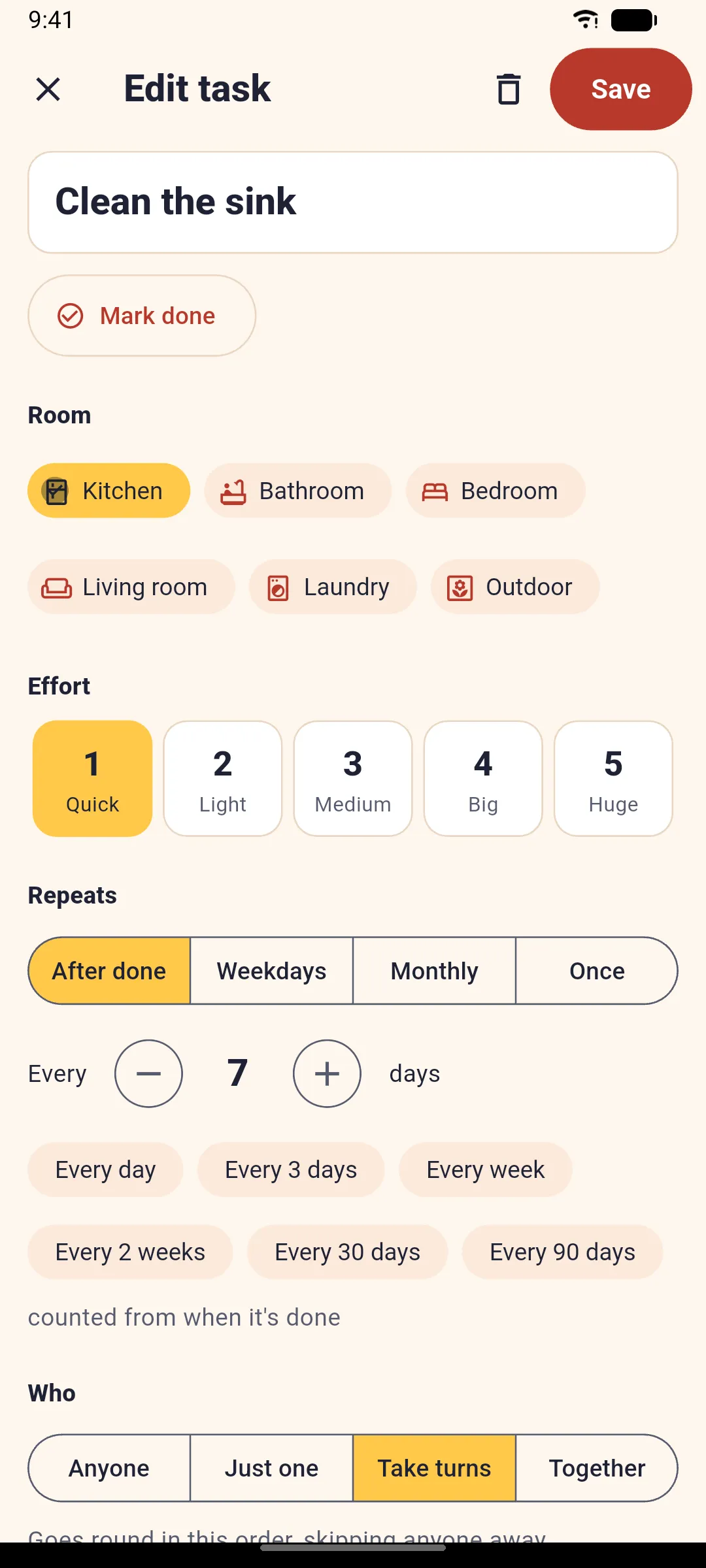
Every chore in Evenchores has an effort score from 1 to 5 (you can change it). When either of you checks a chore off, its points go to whoever did it, and a chore done together splits them.
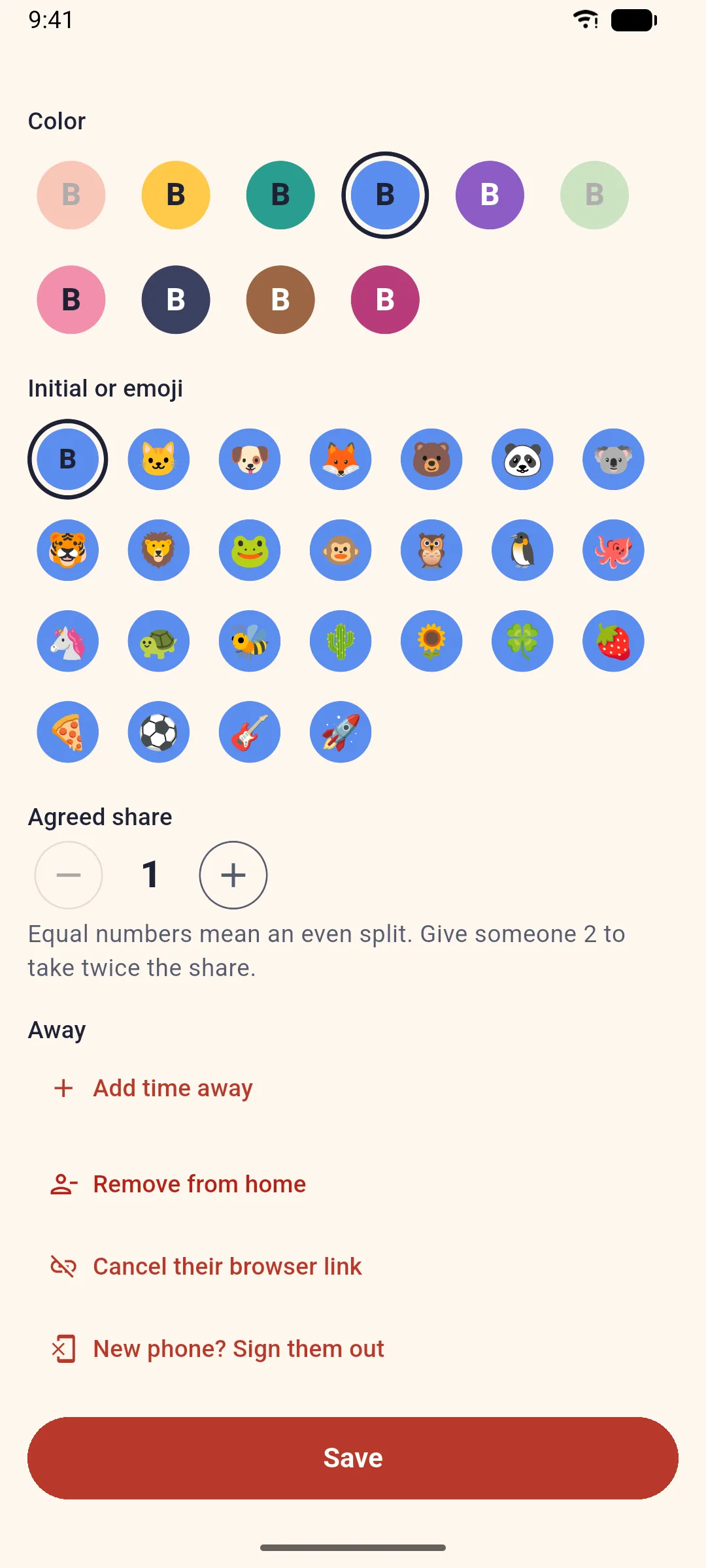
The Split tab adds up the week or the month, as a percentage for each of you next to the share you agreed. To change that share, open Household, tap a person and set their Agreed share. Equal numbers mean 50/50; 3 and 2 means 60/40.
The short version
- Count effort, not chores. A few big jobs can be as much work as lots of small ones.
- Give each chore a size from 1 to 5, together.
- Put planning and remembering on the list too.
- Agree on your split out loud. It doesn’t have to be 50/50.
- Check it once a month and move a chore or two if it’s drifting.