Chore rotation for roommates that stays fair
Taking turns is the easiest way to share chores with roommates. Everybody does the jobs nobody wants, one after another. In practice, most rotations fall apart within a month, and it’s usually for one of three reasons: some jobs are way bigger than others, someone goes out of town, or someone covers for a roommate and nobody remembers whose turn it is anymore.
Here’s how to set one up so that doesn’t happen.
Only rotate the shared stuff
Put the jobs nobody owns in the rotation: the bathroom, the trash and recycling, the kitchen, vacuuming the living room, buying toilet paper and dish soap.
Leave out anything personal. Your room, your laundry and your own dishes are on you.
Small daily things like wiping the counter or emptying the dishwasher usually work better without a rotation. Whoever’s around does it. If you track chores in an app, it still counts for the person who did it.
Weekly zones or turn by turn
There are two common ways to rotate, and most homes use both.
Weekly zones. Each person gets an area for the week (bathroom, kitchen, floors), and next week everyone moves to the next one. Good for the weekly cleaning.
Turn by turn. A chore goes to the next person every time it gets done. Good for the trash, since it doesn’t care what day of the week it is.
A paper chore wheel on the fridge works too, but someone has to remember to turn it, and it can’t skip a roommate who’s away.
Not all chores are the same size
A week of taking out the trash is nothing like a week of cleaning the bathroom. If your rotation treats them the same, whoever keeps landing on the big jobs will notice.
Give each chore a rough size from 1 to 5. Taking out the trash is a 1, vacuuming a 2, the bathroom or the stove a 3, cleaning the oven a 4. Then compare everyone’s totals, not how many chores they did.
Two rules to agree on up front
- If you’re away, your turn is skipped, not saved for later. It goes to the next person. Nobody comes home to a pile of missed chores.
- The next turn goes to whoever’s after the person who actually did it. If Ben cleans the bathroom during Mia’s week, the next turn goes to the person after Ben. Ben did the work, and nobody has to keep track of who owes who.
Example: Ana, Ben and Mia
Three roommates. They rotate the weekly cleaning by zone, and the trash goes turn by turn.
| Week | Bathroom (3) | Kitchen (3) | Floors (2) |
|---|---|---|---|
| 1 | Ana | Ben | Mia |
| 2 | Ben | Mia | Ana |
| 3 | Mia | Ana | Ben |
In week 2, Mia goes home for a long weekend. The trash goes back and forth between Ana and Ben while she’s gone, and her turn comes back when she does. If the kitchen comes up while she’s away, it goes to the next person and the rotation keeps going from there.
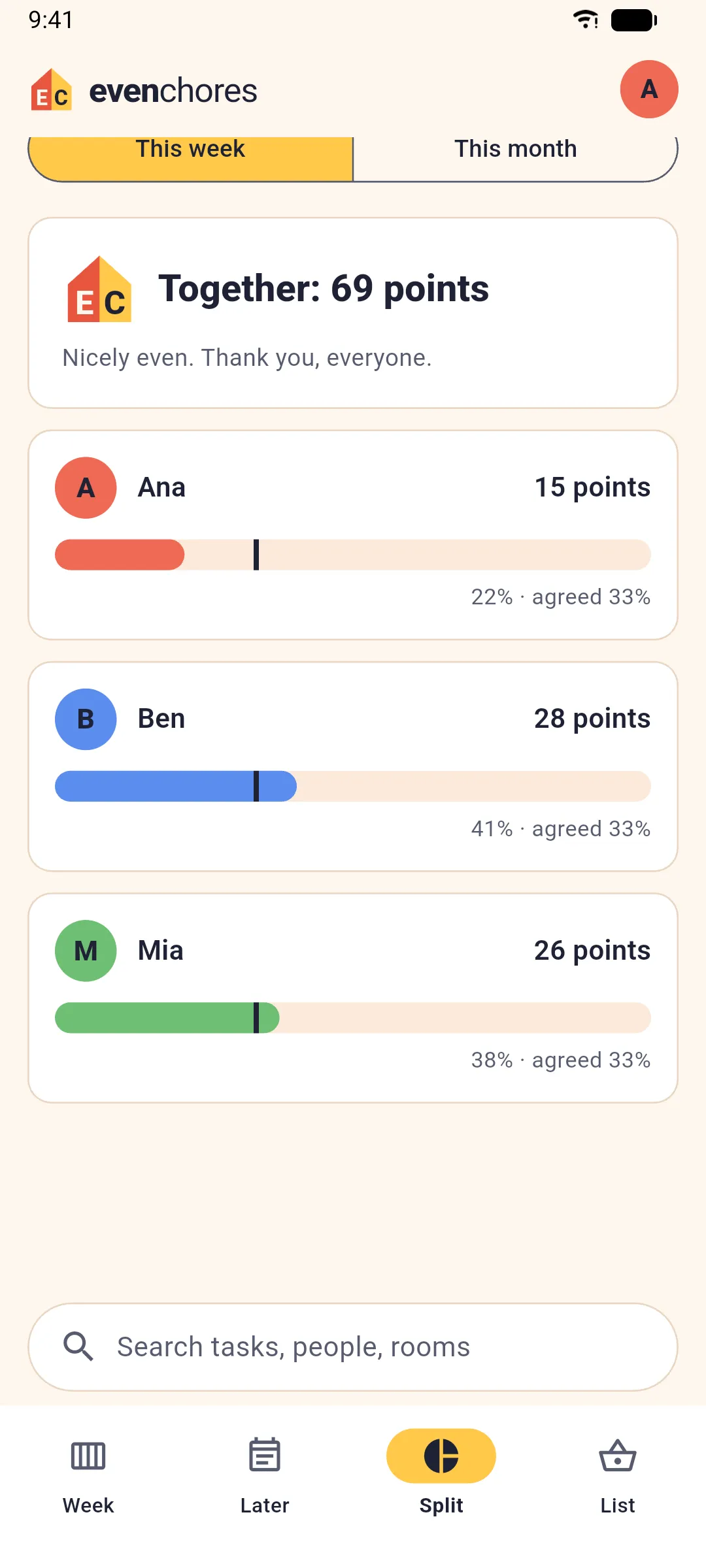
After a month, here’s how the work split out. Pretty even, and nobody had to keep score:
How Evenchores handles it
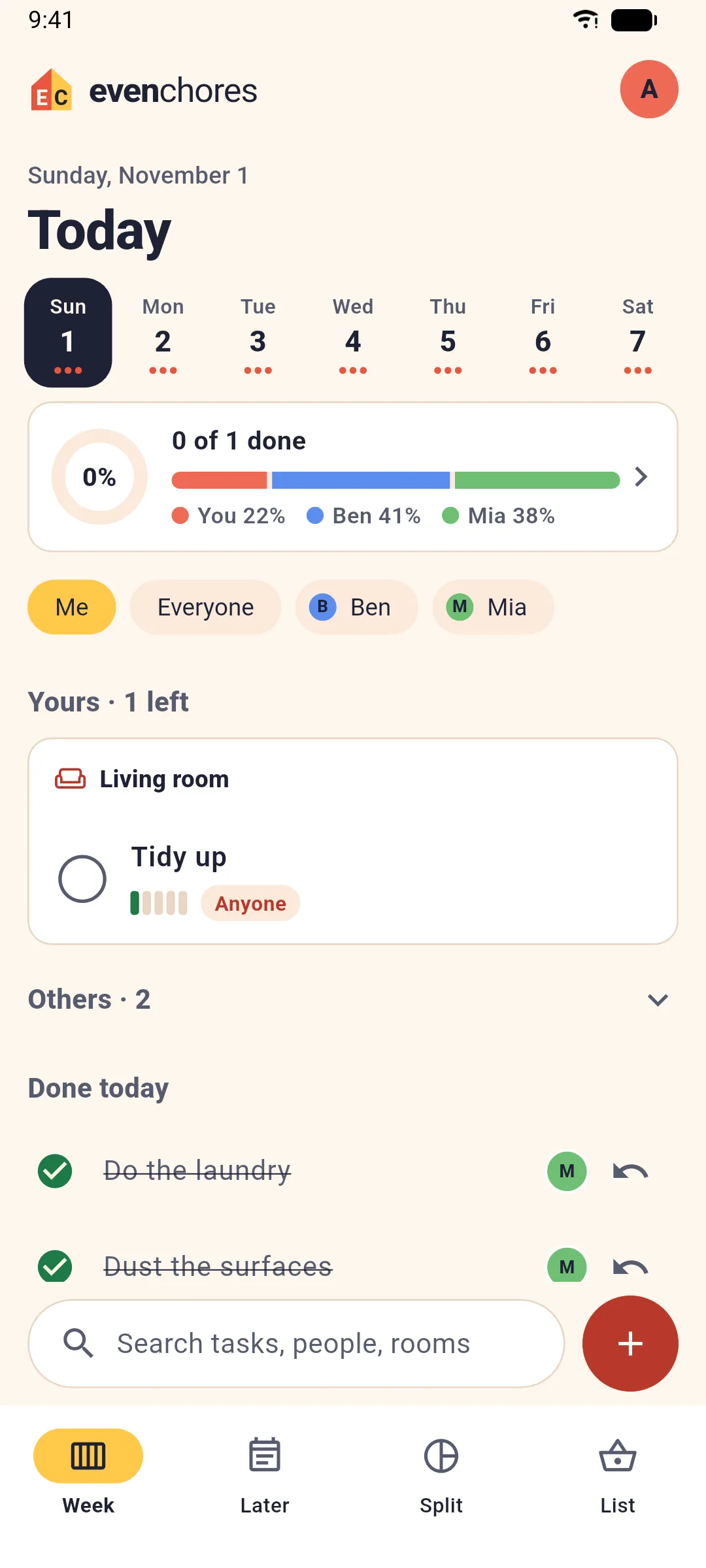
Evenchores keeps track of all of this for you. Open a chore, pick Take turns under Who, and put everyone in order. The chore goes around in that order, skips anyone who’s away, and picks up from whoever checked it off last. Each chore has an effort score from 1 to 5, and the Split tab adds them up for each person. Today shows everyone what’s theirs first:
The short version
- Rotate the shared chores and keep personal ones out.
- Weekly zones for cleaning, turn by turn for the trash.
- Give chores a size and compare totals.
- Away means skipped, and the turn moves on from whoever did it.
- Check the split once a month, not every day.